There is one lever you have direct, immediate control over for shifting your nervous system out of stress mode. You do not need an app for it, though apps help. You do not need equipment. You do not even need a quiet room.
You need your breath.
Why Breathing Works
This is not a relaxation metaphor. Controlled breathing (specifically, slow breathing at roughly 6 breaths per minute) directly activates the parasympathetic branch of your autonomic nervous system through a mechanism that is well-understood and extensively studied.1
Here is what happens:
The vagus nerve connection. Your vagus nerve, the primary parasympathetic highway running from your brainstem to your organs, is physically intertwined with your respiratory system. When you exhale slowly and deeply, the diaphragm drops, pressure in the thoracic cavity changes, and the vagus nerve receives mechanical stimulation. This is not subtle. It triggers a measurable decrease in heart rate (called respiratory sinus arrhythmia) and an increase in heart rate variability within seconds.4
The exhale is the key. Inhalation is associated with sympathetic activation, and your heart rate naturally accelerates slightly with each breath in. Exhalation is associated with parasympathetic activation, and your heart rate decelerates. This is why nearly every effective breathing technique emphasizes a longer exhale than inhale. You are literally spending more time in each breath cycle activating the calming branch of your nervous system.5
The baroreceptor reflex. Slow, deep breathing also stimulates baroreceptors in your aortic arch and carotid sinuses. These pressure sensors respond to the rhythmic changes in blood pressure that slow breathing creates, triggering additional parasympathetic activation through a reflex arc. This compounds the vagal effect.
A comprehensive systematic review of 15 studies found that slow breathing consistently reduced markers of physiological arousal (including heart rate, blood pressure, and cortisol) while increasing HRV across diverse populations.1
The effect is fast. Most studies show measurable changes within 2-5 minutes of starting a slow breathing protocol.2 And unlike most stress interventions, this one works even during the stressful event, not just after.
Box Breathing (4-4-4-4)
Box breathing is the entry point for most people, and for good reason. It is simple, structured, and has a strong evidence base from both clinical research and practical application.
The pattern: Inhale for 4 seconds. Hold for 4 seconds. Exhale for 4 seconds. Hold for 4 seconds. Repeat.
Why it works: The equal timing creates a steady, predictable rhythm that interrupts the irregular, shallow breathing pattern typical of stress. The holds are important because they create moments of stillness that give your baroreceptors consistent pressure signals. The exhalation phase and post-exhale hold account for half the cycle, ensuring substantial parasympathetic activation.
The military connection: Box breathing gained mainstream attention partly through its adoption by Navy SEALs and other military special operations units. Mark Divine, a former SEAL commander, has widely advocated for it as a tool for maintaining composure under extreme pressure. The logic is straightforward: if it works when people are shooting at you, it works when your inbox is overwhelming.
How to practice: Start with four cycles (about one minute). Build to 8-12 cycles (2-3 minutes). The goal is not to force deep breaths, but to slow and regulate the rhythm. If the 4-second holds feel too long initially, start with 3-3-3-3 and work up.
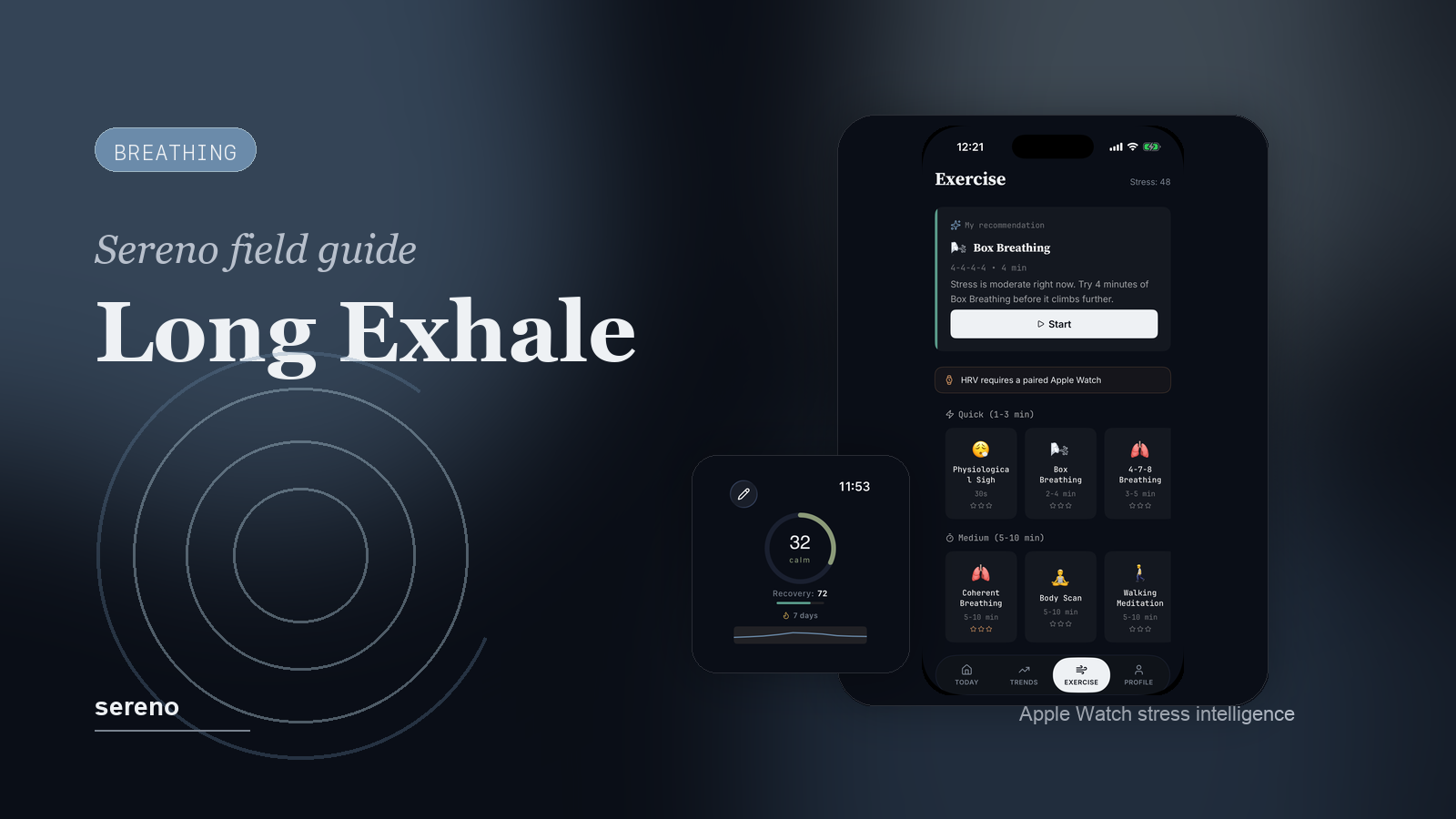
Box breathing is the free technique available in Sereno. We chose it as the default because it requires no prior experience, the equal intervals are easy to remember, and the evidence supports its effectiveness across contexts, from pre-meeting anxiety to difficulty falling asleep.
4-7-8 Breathing
This technique, popularized by Dr. Andrew Weil, shifts the ratio dramatically toward exhalation and adds a component that many people find deeply calming.
The pattern: Inhale through your nose for 4 seconds. Hold for 7 seconds. Exhale through your mouth for 8 seconds. Repeat for 4 cycles.
Why it works: The 8-second exhale is the longest exhalation phase of any common technique, maximizing the parasympathetic activation per breath cycle. The 7-second hold allows CO2 to accumulate slightly, which paradoxically creates a deeper relaxation response when the long exhale follows. The entire cycle lasts 19 seconds, which works out to roughly 3 breaths per minute, well below the 6/minute threshold where most studies show significant autonomic effects.
When to use it: The 4-7-8 is particularly effective as a pre-sleep technique. The long exhalation and extended hold create a drowsiness effect that many people find faster and more reliable than counting sheep. It is also useful for acute anxiety because the cognitive demand of tracking three different durations occupies the prefrontal cortex enough to interrupt rumination.
Caveat: Some people find the 7-second hold uncomfortable at first. If so, start with 4-5-6 and gradually extend. The principle matters more than the exact numbers.
Physiological Sigh
This is the technique with the most interesting recent research behind it. A study from Stanford found that a specific breathing pattern (which they called the “cyclic sigh”) outperformed mindfulness meditation for reducing physiological stress markers in a randomized controlled trial.3
The pattern: Two quick inhales through the nose (the first fills the lungs partially, the second tops them off completely), followed by one long, slow exhale through the mouth. Repeat.
Why it works: The double inhale reinflates the tiny air sacs (alveoli) in your lungs that partially collapse during normal breathing, especially during periods of stress when breathing tends to be shallow. Reinflating them maximizes the surface area for gas exchange, which efficiently offloads CO2. The long exhale then triggers the usual vagal and baroreceptor mechanisms.
The Stanford study is notable because it was the first rigorous head-to-head comparison of specific breathing patterns against meditation. Participants who practiced cyclic sighs for just 5 minutes daily showed greater improvement in mood, reduced respiratory rate, and lower physiological arousal than those who did mindfulness meditation for the same duration.3
When to use it: The physiological sigh is excellent as a quick reset, and even 2-3 cycles can be noticeably calming. It is the technique most suited for acute stress moments because the double inhale is fast and the entire cycle can be done in under 10 seconds.
Coherence Breathing (5.5 Seconds In, 5.5 Seconds Out)
Coherence breathing, sometimes called resonance frequency breathing, is the technique most directly linked to HRV optimization.
The pattern: Inhale for 5.5 seconds. Exhale for 5.5 seconds. No holds. Just smooth, continuous breathing at roughly 5.5 breaths per minute.
Why it works: Research suggests that most adults have a “resonance frequency,” a breathing rate at which heart rate variability reaches its maximum amplitude, that falls between 4.5 and 7 breaths per minute, with 5.5 being the most common.5 At this frequency, respiratory sinus arrhythmia (the natural heart rate fluctuation tied to breathing) synchronizes with baroreceptor oscillations, creating a reinforcing wave that amplifies HRV.
In practical terms: coherence breathing is the pattern that produces the largest measurable shift in autonomic balance in the shortest time. Studies show increases in HRV of 20-40% during coherence breathing compared to normal breathing.1
When to use it: As a daily practice. Unlike the other techniques that work best for acute stress or pre-sleep, coherence breathing is designed for sustained training of your autonomic nervous system. Regular practice (10-20 minutes daily) has been shown to improve resting HRV even when you are not doing the breathing.4
The simplicity advantage: No holds, no counting three different numbers. Just in and out, evenly. This makes it the easiest technique to sustain for longer periods and the least likely to cause the performance anxiety that some people feel with more complex patterns.
Alternate Nostril Breathing
Also known as Nadi Shodhana in the yogic tradition, this technique adds a physical component that many practitioners find helps with focus and presence.
The pattern: Close your right nostril with your thumb. Inhale through the left nostril for 4 seconds. Close both nostrils. Hold for 4 seconds. Release the right nostril (keep left closed with ring finger). Exhale through the right for 4 seconds. Inhale through the right for 4 seconds. Close both. Hold for 4 seconds. Release the left nostril. Exhale through the left for 4 seconds. That is one complete cycle.
Why it works: Beyond the general slow-breathing benefits, alternate nostril breathing appears to activate both hemispheres of the brain more evenly. Research using EEG has shown changes in hemispheric balance during the practice. The physical act of switching nostrils also provides a tactile anchor that helps maintain focus, reducing the mind-wandering that undermines other breathing practices.
Diaphragmatic breathing practices including alternate nostril breathing have been shown to significantly reduce negative affect and improve attention in controlled studies.2
When to use it: As a mindfulness practice. The manual component makes it less suitable for discrete use (in a meeting, for example), but excellent for dedicated practice sessions where the goal is both stress reduction and improved focus.
When to Use Each Technique
Different situations call for different approaches. Here is a practical decision framework:
You are having a panic or acute anxiety moment: Physiological sigh. The double inhale is fast, the entire cycle takes under 10 seconds, and you can do it discretely. Even 3 cycles can produce a noticeable shift.
You cannot fall asleep: 4-7-8 breathing. The extended exhale and hold combination is specifically effective for pre-sleep relaxation. Four cycles take about 75 seconds.
You have a stressful meeting in 5 minutes: Box breathing. The predictable rhythm is easy to maintain while your mind is elsewhere, and 2 minutes of box breathing is enough to measurably lower heart rate.
You want to build long-term resilience: Coherence breathing as a daily practice. Ten to twenty minutes at 5.5 breaths per minute, ideally in the morning, trains your autonomic nervous system to maintain higher baseline HRV.
You have 10 minutes for a focused practice session: Alternate nostril breathing. The manual component forces presence, making it a combined breathing and mindfulness exercise.
General stress during the day: Any slow breathing at roughly 6 breaths per minute. The specific pattern matters less than the rate. Even 2 minutes of deliberately slow breathing produces measurable autonomic effects.
When NOT to Do Breathing Exercises
Breathing exercises are remarkably safe and effective for the vast majority of people. But there are specific situations where certain techniques should be modified or avoided, and understanding these exceptions is part of practicing responsibly.
During a full panic attack, structured breathing can sometimes make things worse. This sounds counterintuitive, since breathing exercises are recommended for anxiety. But during an acute panic attack, the person is often already hyperaware of their breathing. Asking them to follow a complex pattern (counting seconds, holding breath) can increase the sense of losing control. If you are in the middle of a panic episode and structured breathing feels like it is escalating your distress, stop the pattern. Instead, focus on a single, simpler instruction: slow the exhale. Do not worry about counts or holds. Just let each breath out a little more slowly than it came in. Once the acute phase passes, structured techniques become useful again.
People with respiratory conditions should approach breath holds with caution. Conditions like asthma, COPD, or severe respiratory allergies can make breath-holding uncomfortable or even trigger bronchospasm. If you have a respiratory condition, techniques without holds (coherence breathing, physiological sigh) are generally safer starting points than box breathing or 4-7-8, which both include extended holds. As always, discuss new practices with your healthcare provider if you have a diagnosed respiratory condition.
Hyperventilation risk exists with overly aggressive breathing. Breathing too fast, too deep, or too forcefully can reduce CO2 levels in your blood (hypocapnia), causing dizziness, tingling in the hands and face, and lightheadedness. This is the opposite of what slow breathing should do. The key safeguard is that effective breathing exercises are slow and gentle, not deep and forceful. If you feel dizzy during a breathing exercise, you are likely breathing too fast or too deeply. Slow down, reduce the depth, and let the rhythm be comfortable rather than maximal.6
Immediately after eating is not ideal timing. Diaphragmatic breathing involves significant movement of the diaphragm, which sits directly above the stomach. After a large meal, the downward movement of the diaphragm during deep inhalation can cause discomfort, nausea, or acid reflux. Wait at least 30 minutes after a substantial meal before doing a dedicated breathing practice. Brief, gentle breathing (like a few physiological sighs) is fine anytime.
If breathing exercises consistently increase your anxiety, listen to that signal. For a small number of people, particularly those with a history of trauma, focusing attention on bodily sensations (including breath) can trigger dissociative responses or heightened anxiety. This does not mean breathing exercises are harmful for these individuals, but it does mean they may need professional guidance to practice safely. A trauma-informed therapist can help identify which techniques are appropriate and how to approach them gradually.
Do not use breathing exercises as a substitute for medical care. Breathing techniques are powerful complementary tools, not replacements for professional treatment of anxiety disorders, panic disorder, PTSD, or other clinical conditions. If your stress levels are consistently high and interfering with your daily life, that is worth a conversation with a healthcare provider, not just another breathing session.
Breathing for Sleep
The relationship between breathing and sleep onset is one of the most practically useful applications of these techniques. Sleep requires a shift from sympathetic to parasympathetic dominance, essentially the exact shift that slow breathing produces. This is why breathing exercises are among the most effective non-pharmacological tools for falling asleep.
Why sleep-specific techniques emphasize exhalation. Your body interprets extended exhalation as a safety signal. When you are in danger, your breathing naturally becomes short and shallow, with emphasis on quick inhalation. Reversing that pattern, with long, slow exhales, sends a direct signal through the vagus nerve that the environment is safe and that it is appropriate to disengage from vigilance. This is exactly the neurological state required for sleep onset.
The 4-7-8 technique is particularly effective for sleep because the 8-second exhale maximizes parasympathetic activation per breath cycle, while the 7-second hold creates a brief CO2 accumulation that deepens the subsequent relaxation. The total cycle time of 19 seconds produces only about 3 breaths per minute, well below the threshold where strong autonomic effects occur. Many people report that 3 to 4 cycles are sufficient to induce drowsiness.
A study on paced breathing for insomnia found that participants who practiced slow breathing before bed showed significant improvements in both sleep onset latency (how long it takes to fall asleep) and overall sleep quality, with corresponding increases in overnight HRV.7 The effect was not just subjective: the physiological markers of sleep quality improved alongside the self-reported experience.
Timing matters for sleep breathing. The optimal window is in bed, lights off, ready to sleep. Practicing breathing exercises 30 minutes before bed while still engaged in other activities is less effective than practicing them as the very last thing you do before attempting sleep. The goal is to carry the parasympathetic activation directly into sleep onset without interruption.
Combine breathing with progressive muscle relaxation for stubborn insomnia. If breathing alone is not enough to quiet a racing mind, try this sequence: start with 4 cycles of 4-7-8 breathing to shift your autonomic baseline, then systematically tense and release muscle groups from toes to forehead, synchronizing the releases with slow exhales. The combination addresses both the physiological activation (through breathing) and the physical tension (through muscle relaxation) that prevent sleep.
What to do when breathing “is not working” for sleep. If you have been trying to breathe your way to sleep for 20 minutes and you are still wide awake, get up. Lying in bed frustrated while attempting breathing exercises creates an association between your bed and frustration, which worsens insomnia over time. Get up, go to another room, do something low-stimulation for 15 to 20 minutes, then return to bed and try again. This is a core principle of cognitive behavioral therapy for insomnia (CBT-I), and it is more effective than forcing the issue.
Sereno’s breathing sessions include a “Bedtime” context option that adjusts the visual interface (dimmer, warmer colors) and selects techniques optimized for sleep onset. After the session, it tracks whether your overnight HRV improved relative to nights without a pre-sleep breathing session, giving you data on whether the practice is objectively benefiting your sleep quality.
Building a Daily Practice
Knowing five breathing techniques is useful only if you actually practice them. The research consistently shows that the benefits of breathing exercises accumulate with regular practice, not just through individual sessions.8 Here is how to build a sustainable habit.
Start absurdly small. The biggest mistake people make is committing to a 20-minute daily practice on day one. Within a week, they have skipped three sessions, feel guilty, and abandon the whole thing. Instead, start with one minute. One minute of box breathing. Every day. The goal for the first two weeks is not stress reduction. It is habit formation. Once the habit is automatic, duration can increase naturally.
Anchor it to an existing routine. Habits that attach to existing behaviors stick better than habits that float freely in your schedule. “After I pour my morning coffee, I do one minute of coherence breathing.” “After I sit down at my desk, I do two minutes of box breathing before opening email.” “After I get into bed, I do four cycles of 4-7-8.” The anchor provides the cue that triggers the behavior without requiring willpower or memory.
Use data as motivation, not judgment. One of the most effective motivators for maintaining a breathing practice is seeing it work in your data. When you can look at your stress trends and see that days with a morning breathing session consistently show lower afternoon stress scores, the practice stops feeling like a wellness chore and starts feeling like a practical tool you use because it measurably helps. Sereno tracks this correlation automatically, showing you the relationship between your breathing sessions and your subsequent stress patterns.
Expect nothing from individual sessions, everything from the trend. Some breathing sessions will feel profoundly calming. Others will feel like you are just sitting there counting. The variation in subjective experience between sessions is normal and not particularly informative. What matters is the cumulative effect on your autonomic baseline over weeks and months. Regular practitioners of coherence breathing typically see measurable improvements in resting HRV within 4 to 6 weeks, independent of how any individual session felt.4
Have a default and a toolkit. Choose one technique as your daily default, the one you do regardless of circumstances. Box breathing is the most common choice because of its simplicity. Then keep the others as situation-specific tools: physiological sigh for acute stress, 4-7-8 for sleep, coherence breathing for dedicated practice sessions. Having a default removes the decision of what to do and reduces the friction that prevents practice.
Track consistency, not perfection. Missing a day is not failure. Missing a week because one missed day made you feel like giving up is the actual obstacle. Many people find it helpful to track a simple yes/no: “Did I breathe today?” A streak of 5 out of 7 days per week is excellent and sustainable. Perfection is neither necessary nor realistic.
Building a Breathing Practice
The research is clear that even brief breathing interventions (as short as 5 minutes daily) produce measurable improvements in stress markers and mood.3 But knowing this and actually doing it are different problems.
When we built the breathing exercise system in Sereno, we designed it around several insights from both research and user behavior:
Haptic guidance removes the cognitive load. Counting seconds while trying to relax is counterproductive for many people. Sereno uses gentle haptic pulses on the wrist (through both the iPhone and Apple Watch) to signal inhale, hold, and exhale phases. You can close your eyes and follow the rhythm without thinking about numbers.
Live Activities keep you in the flow. For longer sessions, a breathing Live Activity shows your progress on the lock screen and Dynamic Island, so you do not need to keep the app open or stare at a screen. The goal is eyes closed, mind quiet, body guided.
Two minutes is a legitimate session. Research consistently shows that physiological effects begin within 2-3 minutes of slow breathing.1 We deliberately designed the default session length to be achievable rather than aspirational. A two-minute box breathing session that you actually do is infinitely more valuable than a twenty-minute meditation session you keep postponing.
Post-session HRV data closes the feedback loop. After a breathing session, Sereno tracks your HRV response. Did it improve? By how much? Over time, this creates a personal evidence base: you can see which techniques produce the largest HRV shifts for your specific physiology. This feedback transforms breathing from a vague wellness practice into a measurable skill you can improve.
The most effective breathing practice is the one you actually do. Start with box breathing because it is simple. Try coherence breathing if you want to commit to a daily habit. Use the physiological sigh for acute moments. And pay attention to your data, which will tell you which technique your body responds to best.
References
- Zaccaro A, et al. How Breath-Control Can Change Your Life: A Systematic Review on Psycho-Physiological Correlates of Slow Breathing. Front Hum Neurosci. 2018;12:353. PMID: 30245619
- Ma X, et al. The Effect of Diaphragmatic Breathing on Attention, Negative Affect and Stress in Healthy Adults. Front Psychol. 2017;8:874. PMID: 28626434
- Balban MY, et al. Brief structured respiration practices enhance mood and reduce physiological arousal. Cell Rep Med. 2023;4(1):100895. PMID: 36630953
- Gerritsen RJS, Band GPH. Breath of Life: The Respiratory Vagal Stimulation Model of Contemplative Activity. Front Hum Neurosci. 2018;12:397. PMID: 30356789
- Russo MA, et al. The physiological effects of slow breathing in the healthy human. Breathe (Sheff). 2017;13(4):298-309. PMID: 29209423
- Jerath R, et al. Self-regulation of breathing as a primary treatment for anxiety. Appl Psychophysiol Biofeedback. 2015;40(2):107-115. PMID: 25869930
- Tsai HJ, et al. Efficacy of paced breathing for insomnia: enhances vagal activity and improves sleep quality. Psychophysiology. 2015;52(3):388-396. PMID: 25234581
- Laborde S, et al. Heart Rate Variability and Cardiac Vagal Tone in Psychophysiological Research. Front Psychol. 2017;8:213. PMID: 28265249
References
- Zaccaro A, et al. How Breath-Control Can Change Your Life: A Systematic Review on Psycho-Physiological Correlates of Slow Breathing. Front Hum Neurosci. 2018;12:353. [PMID: 30245619]
- Ma X, et al. The Effect of Diaphragmatic Breathing on Attention, Negative Affect and Stress in Healthy Adults. Front Psychol. 2017;8:874. [PMID: 28626434]
- Balban MY, et al. Brief structured respiration practices enhance mood and reduce physiological arousal. Cell Rep Med. 2023;4(1):100895. [PMID: 36630953]
- Gerritsen RJS, Band GPH. Breath of Life: The Respiratory Vagal Stimulation Model of Contemplative Activity. Front Hum Neurosci. 2018;12:397. [PMID: 30356789]
- Russo MA, et al. The physiological effects of slow breathing in the healthy human. Breathe (Sheff). 2017;13(4):298-309. [PMID: 29209423]
- Jerath R, et al. Self-regulation of breathing as a primary treatment for anxiety. Appl Psychophysiol Biofeedback. 2015;40(2):107-115. [PMID: 25869930]
- Tsai HJ, et al. Efficacy of paced breathing for insomnia: enhances vagal activity and improves sleep quality. Psychophysiology. 2015;52(3):388-396. [PMID: 25234581]
- Laborde S, et al. Heart Rate Variability and Cardiac Vagal Tone in Psychophysiological Research. Front Psychol. 2017;8:213. [PMID: 28265249]

Sereno Team
Sereno is a stress management app that combines biometric data, behavior patterns, and context to help you understand and manage stress.
More from Sereno Team