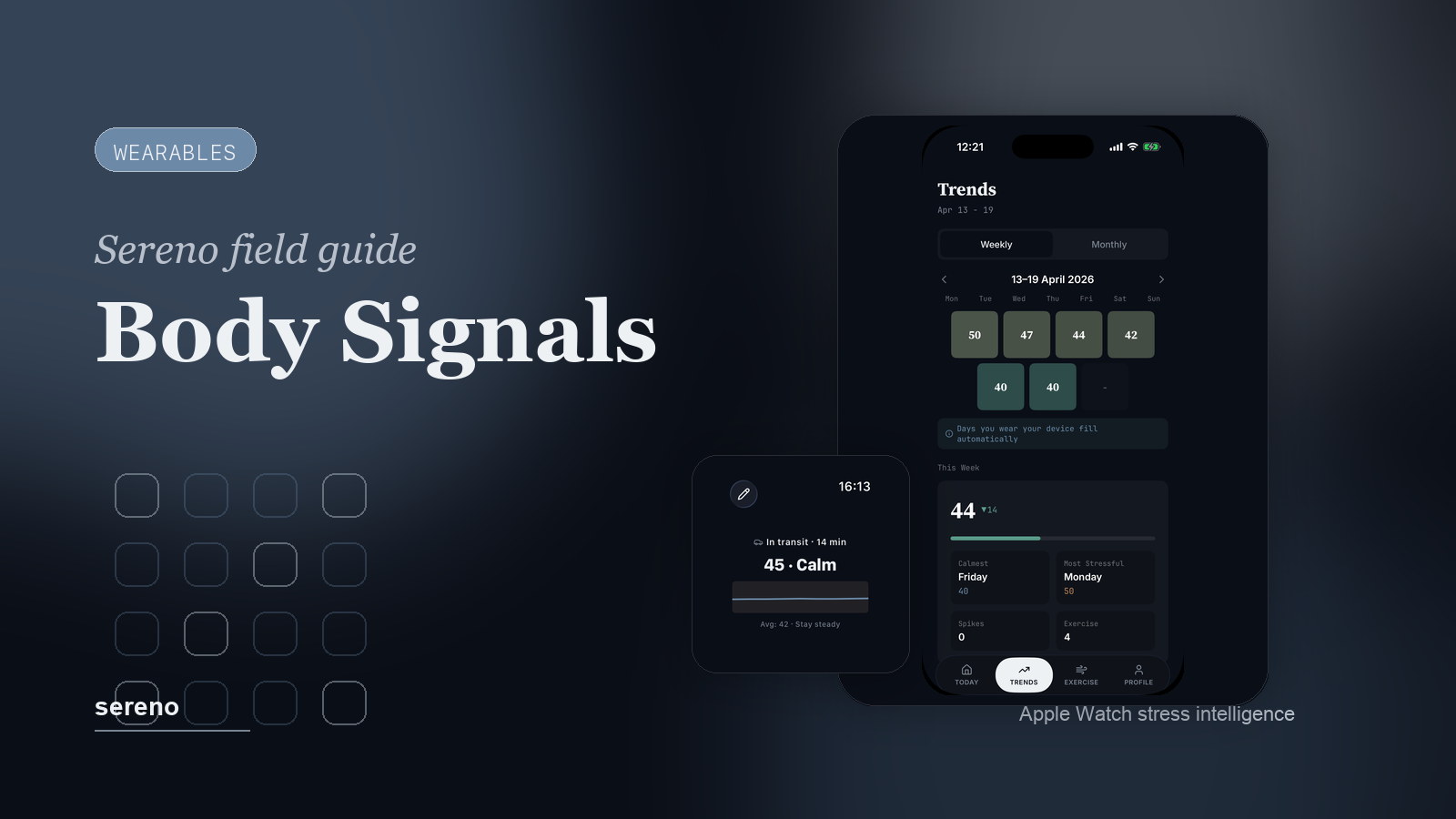
Your wearable is collecting an extraordinary amount of data about your body. Every few seconds, an optical sensor on your wrist is measuring blood flow, calculating heart rate, and deriving metrics that, two decades ago, required a hospital visit. The problem is not the data collection. It is that most people never learn how to turn those numbers into something useful.
If you wear an Apple Watch, Oura Ring, Fitbit, or Whoop, you already have the hardware for meaningful stress tracking. What you might be missing is the interpretation layer.
Your Wrist Already Knows
Wearable health sensors have reached a level of accuracy that would have seemed unlikely even a few years ago. The landmark Apple Heart Study enrolled over 400,000 participants and demonstrated that a consumer smartwatch could reliably identify irregular heart rhythms, including atrial fibrillation, with a positive predictive value of 84%.1 This was not a niche research device. It was the same Apple Watch people use to check text messages and set timers.
For stress tracking specifically, the key signals your wearable captures are:
Heart rate covers both your current rate and your resting heart rate, which is typically calculated once daily from your lowest sustained readings. Resting heart rate elevation above your personal baseline is one of the simplest and most reliable indicators of accumulated physiological stress.
Heart rate variability (HRV) is the beat-to-beat variation in your heart rhythm, measured in milliseconds. This is the gold standard autonomic nervous system metric. Higher HRV generally indicates better parasympathetic function and greater adaptive capacity. Lower HRV indicates sympathetic dominance, often associated with stress, fatigue, or illness. If you want to go deeper on this metric, our HRV guide explains what the numbers mean and how to interpret them.
Sleep data includes total duration, sleep stages (light, deep, REM), sleep efficiency, and overnight physiological trends. Sleep quality directly affects next-day stress resilience, and sleep data provides essential context for interpreting daytime readings.
Activity data encompasses steps, exercise type and duration, and general movement patterns. Physical activity profoundly affects HRV and heart rate readings, and without accounting for it, stress interpretations can be wildly off.
The data exists. The question is what to do with it.
What Each Wearable Measures
Not all wearables capture the same data, and the differences matter for stress tracking.
Apple Watch is the most comprehensive sensor platform for users in the Apple ecosystem. It captures heart rate continuously, HRV (as SDNN from single-lead ECG and optical sensor), resting heart rate, blood oxygen, respiratory rate, wrist temperature, noise levels, and sleep stages. All of this flows into Apple Health, which serves as a centralized health data repository. The Apple Watch’s particular strength is continuous daytime monitoring, as it captures HRV and heart rate data throughout the day, not just overnight. Learn more about Apple Watch stress tracking with Sereno.
Oura Ring excels at overnight data. Its form factor (a ring worn 24/7) produces exceptionally clean nighttime readings because the finger has stronger arterial pulse signals than the wrist. Oura provides detailed overnight HRV, heart rate, body temperature deviation, sleep stages, and a daily “Readiness Score” that synthesizes recovery metrics. Its limitation is daytime activity tracking: it captures movement well but does not provide continuous daytime HRV. Learn more about Oura Ring stress tracking with Sereno.
Fitbit provides a “Stress Management Score” (available on Premium) that combines HRV responsiveness, exertion balance, and sleep patterns. Fitbit’s particular strength is its large user base and the comparative data it can provide, though cross-person comparison has significant limitations. It is worth noting that Fitbit does not sync with Apple Health natively, which means its data requires direct API access for third-party apps. Learn more about Fitbit stress tracking with Sereno.
Whoop is the most recovery-focused wearable. It provides daily Strain, Recovery, and Sleep scores derived from continuous HRV monitoring. Whoop captures HRV every night and bases its recovery score heavily on overnight parasympathetic activity. The subscription model and lack of a screen position it as a serious athlete and biohacker tool rather than a mainstream smartwatch. Learn more about Whoop stress tracking with Sereno.
Each device has trade-offs. What they all share is the ability to capture the fundamental signals (heart rate, HRV, and sleep) that underpin meaningful stress tracking.
The Apple Health Bridge
For iOS users, Apple Health functions as a universal health data repository. This is important because it means you are not locked into any single wearable’s app or algorithm.
The data pipeline works like this: your wearable collects raw sensor data, processes it into health metrics, and writes those metrics to Apple Health. Once in Apple Health, any authorized app can read the data and apply its own analysis.
This is exactly how Sereno works. It reads from Apple Health (heart rate, HRV (SDNN), resting heart rate, sleep data, respiratory rate, and more) regardless of which device originally captured the data. If you wear an Apple Watch, the data flows directly. If you wear an Oura Ring, the Oura app writes to Apple Health, and Sereno reads it from there. and Whoop follow the same pattern through their respective Apple Health integrations.
The practical benefit is flexibility. You can switch wearables without losing your stress tracking history, because the data lives in Apple Health, and Sereno’s analysis is based on your personal baseline, not on any device-specific metric. Your baseline recalibrates as new data flows in, regardless of its source.
This also means that if you wear multiple devices (an Apple Watch during the day and an Oura Ring at night, for example), Sereno can synthesize data from both, since Apple Health merges sources automatically.
Beyond Raw Numbers
Here is the fundamental problem with most wearable apps: they show you numbers without giving you the context to interpret them.
Your Apple Watch might tell you your HRV is 42 ms. Is that good? Bad? Meaningful? Without context, it is just a number.
Raw HRV values are meaningless in isolation for three reasons:
Individual variation is enormous. A healthy 25-year-old athlete might have an HRV of 80 ms. A healthy 55-year-old might have an HRV of 30 ms. Neither number is inherently “good” or “bad.” They reflect age, genetics, fitness history, and dozens of other factors.
Time of day matters. Your HRV at 7 AM is different from your HRV at 3 PM, which is different from your HRV at midnight. This follows your circadian cortisol rhythm and is completely normal. Comparing a morning reading to an afternoon reading is comparing apples to oranges.
Activity context changes everything. Your HRV during a run should be lower than your HRV while sitting. If your wearable app shows you a low HRV reading captured during exercise and you interpret it as “stress,” you have just been misled by decontextualized data.
When we built Sereno’s stress scoring engine, these three problems shaped every design decision. The engine works by comparing your current HRV against your personal rolling baseline: not a population average, not a single historical number, but a statistical model of your recent patterns that accounts for your individual physiology. It normalizes for time of day, adjusting expectations based on your circadian phase. And it accounts for physical activity, so that HRV readings during exercise are interpreted differently from readings at rest.
The result is that Sereno’s stress score means the same thing regardless of your age, fitness level, or the time of day. A score of 70 means your stress indicators are notably elevated relative to your own normal, whether your raw HRV is 25 ms or 75 ms.
Research has consistently shown that the accuracy of consumer wearables varies significantly by context, and optical heart rate sensors can be less accurate during physical activity due to motion artifacts.2 A 24-hour validation study found that while consumer wearables generally perform well for heart rate during rest and light activity, accuracy decreases during vigorous exercise.3 This is another reason why contextual interpretation matters more than raw numbers.
Setting Up Your Wearable for Best Results
The data quality from your wearable depends significantly on how consistently you wear it and how you configure it.
Wear it to bed. Overnight data is the most valuable for stress and recovery tracking. If you only wear your device during the day, you are missing the single most informative window: the period when your autonomic nervous system either recovers or does not.
Wear it consistently. Your personal baseline is only as reliable as the data behind it. Gaps in wear create gaps in your baseline, which reduce the accuracy of deviation-based analysis. Aim for at least 18-20 hours of daily wear.
Charge strategically. Most wearables need 30-60 minutes of charging daily. The best time is usually in the evening before bed (so you start sleep tracking with a full battery) or during a sedentary period like watching a show. Avoid charging during sleep or first thing in the morning, as these are when the most valuable data is captured.
Enable background sync. Make sure your wearable app has permission to write to Apple Health in the background. If background sync is disabled, there can be delays between when data is captured and when it becomes available to apps like Sereno.
Keep the sensor clean and snug. Optical heart rate sensors work by shining light into your skin and measuring the reflected light to detect blood volume changes. A loose fit, dirty sensor, or hairy wrist can all introduce noise. The device should be snug enough to stay in place during sleep but not so tight it is uncomfortable.
Common Wearable Mistakes
Even with good data, interpretation errors are common. Here are the ones we see most often:
Checking numbers too frequently. Heart rate and HRV fluctuate constantly in response to posture, breathing, hydration, temperature, and dozens of other transient factors. Checking your HRV every hour and reacting to each reading is like checking the stock market every minute, and it creates anxiety about normal noise. Focus on daily and weekly trends, not individual readings.
Comparing with others. This is the single most common and most harmful mistake. Someone posts their HRV of 85 ms on social media, and you feel anxious about your 38 ms. But their number and your number are not comparable. HRV is deeply individual. The only meaningful comparison is you versus your own recent history. A comprehensive reliability study confirmed that between-person variation in wearable-derived metrics is substantially larger than within-person variation, underscoring the futility of cross-person comparison.4
Ignoring trends for single readings. One low HRV reading does not mean you are sick or overstressed. One high reading does not mean you are fully recovered. A single data point is a snapshot influenced by dozens of transient factors. It is the pattern over days and weeks that tells the story.
Attributing causation to correlation. Your HRV dropped on the same day you had a difficult meeting. Did the meeting cause the drop? Maybe. But maybe you also slept poorly the night before, had three coffees, and skipped lunch. Without systematically tracking multiple variables, attribution is guesswork. This is where apps that track multiple signals simultaneously (sleep, activity, substance intake, stress) become genuinely valuable.
Obsessing over optimization. The goal of stress tracking is awareness and better decision-making, not achieving a “perfect” HRV score. If tracking your data is itself becoming a source of anxiety, you have crossed a line from useful to counterproductive. The numbers serve you, not the other way around.
Battery Life Considerations
One of the most practical factors in choosing and using a wearable for stress tracking is battery life, because a dead device produces no data, and the most important data windows (overnight sleep and early morning) are exactly when many devices run out of charge.
Apple Watch typically lasts 18 to 36 hours on a single charge, depending on the model, usage intensity, and age of the battery. The Series 9 and Ultra 2 have improved significantly, with many users getting a full day plus night on a single charge. However, heavy use (frequent app launches, workout tracking, always-on display) can drain the battery faster. The most reliable charging strategy for stress tracking is to charge during a consistent low-value window: while you shower and get ready in the morning, or during an evening wind-down period. This ensures the device is charged for both daytime and overnight data capture. If you find your Apple Watch dying overnight, consider disabling the always-on display and reducing notification frequency, both of which can extend battery life by several hours.
Oura Ring excels here with 4 to 7 days of battery life. This means you can wear it continuously without worrying about charging strategies, and the likelihood of missing overnight data due to a dead battery is minimal. The trade-off is that Oura does not provide continuous daytime HRV, so the longer battery life partly reflects less intensive sensor usage during the day.
**** devices vary widely depending on the model. Basic fitness trackers may last 7 or more days. Advanced multisport watches with GPS can last 2 to 3 weeks in smartwatch mode. For stress tracking purposes, the long battery life means less charging anxiety and more consistent data capture. The downside is that some models only sample HRV at specific intervals rather than continuously.
Fitbit devices typically last 5 to 7 days, providing a comfortable middle ground. You can usually charge once per week and maintain continuous data capture. The newer Fitbit Sense and Charge models prioritize stress tracking features and maintain HRV sampling throughout their battery cycle.
Whoop provides approximately 4 to 5 days of battery life, and its battery pack design allows charging while wearing the device. This is a significant advantage for continuous data capture, as you never need to remove the device to charge it. The sliding battery charger clips onto the device and charges it in about 60 to 90 minutes without interrupting data collection.
The practical principle is simple. Whatever device you wear, establish a charging routine that protects your two most valuable data windows: overnight (for sleep and recovery data) and early morning (for baseline stress assessment). Everything else is secondary.
Data Accuracy Comparison
Not all wearable sensors are created equal, and the accuracy of the data your device provides directly affects the quality of any stress analysis built on top of it. Understanding the strengths and limitations of different sensors helps you interpret your data more realistically.
Optical heart rate sensors (photoplethysmography, or PPG) are the standard technology in wrist-worn devices. They work by shining green LED light into the skin and measuring the light reflected back. Blood volume changes with each heartbeat, altering the reflected light pattern. From these patterns, the sensor derives heart rate and, through additional algorithms, HRV.
A large-scale study evaluating seven consumer wearables found that most devices achieved heart rate accuracy within 5% during rest, but accuracy degraded during physical activity, with errors of 10% or more during vigorous exercise.5 The primary source of error is motion artifact: when your wrist moves during exercise, the sensor has difficulty distinguishing blood volume changes from motion-induced changes in reflected light.2
Wrist versus finger placement matters. The Oura Ring measures from the palmar arteries in the finger, which are closer to the skin surface and provide a stronger pulse signal than the wrist. Research suggests that finger-based PPG sensors produce cleaner signals during sleep, which is when the most important recovery data is captured. For wrist-worn devices, the quality of the sensor and the snugness of the fit become more important factors.
HRV accuracy from consumer wearables is generally good during rest but variable during activity. A systematic review of wearable HRV measurement found that most consumer devices provide HRV measurements that correlate reasonably well with clinical-grade ECG during stationary conditions, but accuracy decreases significantly during movement.6 This is why overnight HRV, captured during hours of minimal movement, is considered more reliable than daytime HRV readings from wrist-worn devices.
What this means practically. For stress tracking, the data accuracy picture is encouraging. The most important data, overnight HRV and resting heart rate, is captured during conditions (stillness, consistent sensor contact) where consumer wearables perform well. Daytime stress readings based on HRV should be interpreted with more caution, particularly during or immediately after physical activity. Sereno’s stress scoring engine accounts for this by weighting data differently based on activity context and by using rolling averages that smooth out individual noisy readings.
Skin tone and tattoos can affect sensor accuracy. Optical sensors perform differently across skin tones because melanin absorbs green light at different rates. Some devices have addressed this with additional sensor wavelengths (red and infrared in addition to green), but the effect is worth noting. Similarly, tattoos under the sensor area can interfere with light transmission, and some users with wrist tattoos find that accuracy improves when wearing the device on their non-tattooed wrist.
Temperature sensors vary in precision. Apple Watch (Series 8 and later) and Oura Ring both include wrist or finger temperature sensors. These can provide useful supplementary data for detecting illness, menstrual cycle phases, and recovery status. However, wrist temperature is less precise than core body temperature, and readings are influenced by ambient temperature, bedding, and room conditions. Temperature trends over multiple nights are more reliable than any single night’s reading.
Which Wearable for Which Lifestyle?
There is no universally “best” wearable for stress tracking. The right device depends on your priorities, your daily routine, and what you are willing to compromise on. Here is a practical framework for thinking about the choice.
If you want the most comprehensive data and are already in the Apple ecosystem: Apple Watch is the clear choice. It provides continuous daytime HRV, heart rate, sleep stages, blood oxygen, respiratory rate, noise levels, and wrist temperature. It syncs natively with Apple Health. The trade-off is daily charging and the relatively bulky form factor for sleep.
If sleep and recovery data are your top priority: Oura Ring is purpose-built for this. Its ring form factor produces clean overnight data, it is comfortable to wear during sleep, and its multi-day battery life means you will rarely miss a night. The trade-off is limited daytime HRV data and the absence of a screen for real-time feedback.
If you are budget-conscious and want a solid starting point: Fitbit devices offer good sleep and stress tracking at a lower price point than Apple Watch or Oura. The Charge series provides a slim, comfortable form factor with multi-day battery life. The trade-off is that Fitbit does not sync natively with Apple Health (it requires the Google Health Connect workaround on Android, or direct API access on iOS), which limits integration with third-party analysis tools.
If you are an athlete or serious about recovery optimization: Whoop provides the most recovery-focused analysis, with detailed strain, recovery, and sleep scores. The strap form factor is unobtrusive, and the clip-on charger means you never need to remove it. The trade-off is the subscription cost (there is no one-time purchase option) and the lack of a screen.
If you want to combine devices: Many serious trackers wear an Apple Watch during the day and an Oura Ring at night, getting the best of both worlds. This works well with Sereno because Apple Health merges data from multiple sources, and the analysis engine works with whatever data is available. The ring provides cleaner overnight data, while the watch provides richer daytime context. The cost of two devices is the obvious trade-off.
A word about future-proofing. The wearable market is evolving rapidly. New sensors, improved algorithms, and better battery technology arrive yearly. Rather than optimizing for the “perfect” device today, focus on building consistent tracking habits. The data from any reliable device, worn consistently, is far more valuable than sporadic data from the most advanced device.
Regardless of which device you choose, the fundamental requirement for meaningful stress tracking is the same: consistent wear, particularly overnight, with data flowing into a system that can contextualize and personalize the analysis. The hardware captures the signal. The interpretation is what makes it useful.
Getting the Most from Your Data
Once you have consistent data flowing and you have avoided the common mistakes, here is how to extract genuine value:
Establish a weekly review habit. Rather than checking daily numbers reactively, set aside five minutes once a week to look at trends. Questions to ask: Is my average HRV trending up, down, or flat? Are my highest-stress days clustered on specific weekdays? Does my sleep quality correlate with next-day stress? What happened differently on my best and worst days?
Correlate lifestyle factors. The most actionable insights come from connecting stress data with lifestyle choices. Track the basics (alcohol, caffeine timing, exercise, sleep schedule) and look for patterns. Many people discover specific triggers they were not aware of: a particular meeting format, a recurring schedule conflict, or a dietary habit that consistently correlates with poor recovery.
Use breathing exercises when stress spikes. Your wearable data can serve as a trigger for intervention. If you notice your stress is elevated mid-afternoon, that is the moment for a 2-minute breathing exercise, not tonight or tomorrow. Real-time awareness enables real-time action. Our breathing techniques guide covers five evidence-based approaches for different situations.
Track the impact of changes. When you make a lifestyle adjustment (cutting caffeine after noon, adding a morning walk, starting a bedtime breathing practice), watch your data for the next 2-3 weeks. Meaningful changes should show up as shifts in your trends. If they do not, the intervention either is not working or needs more time. Data turns vague intentions (“I should sleep better”) into testable hypotheses (“Cutting caffeine after noon improved my deep sleep by 15% over two weeks”).
Be patient with baselines. When you first start tracking, or when you switch devices, your personal baseline needs time to stabilize. Two to three weeks of consistent data is the minimum for a reliable baseline. During this period, daily scores may seem erratic. That is normal. The system is learning your patterns.
Your wearable is already doing the hard part: continuously sensing, recording, and transmitting physiological data. The opportunity is in turning that data stream into something you actually use to make better decisions about your stress, your recovery, and your health. The numbers are there. The question is whether you are reading them.
Explore by Device
We have dedicated guides for each supported wearable:
- Apple Watch Stress Tracking: watchOS complication, wrist haptics, guided breathing
- Oura Ring Stress Tracking: overnight HRV, daytime stress intelligence
- Fitbit Stress Tracking: real-time scoring beyond daily Stress Management Score
- Whoop Stress Tracking: stress intelligence for recovery and strain
References
- Perez MV, et al. Large-Scale Assessment of a Smartwatch to Identify Atrial Fibrillation. N Engl J Med. 2019;381(20):1909-1917. PMID: 31722151
- Bent B, et al. Investigating sources of inaccuracy in wearable optical heart rate sensors. NPJ Digit Med. 2020;3:18. PMID: 32047863
- Nelson BW, Allen NB. Accuracy of Consumer Wearable Heart Rate Measurement During an Ecologically Valid 24-Hour Period. PLoS One. 2019;14(3):e0213336. PMID: 30849098
- Fuller D, et al. Reliability and Validity of Commercially Available Wearable Devices for Measuring Steps, Energy Expenditure, and Heart Rate. JMIR Mhealth Uhealth. 2020;8(9):e18694. PMID: 32897239
- Shcherbina A, et al. Accuracy in Wrist-Worn, Sensor-Based Measurements of Heart Rate and Energy Expenditure in a Diverse Cohort. J Pers Med. 2017;7(2):3. PMID: 28538708
- Georgiou K, et al. Can Wearable Devices Accurately Measure Heart Rate Variability? A Systematic Review. Folia Med (Plovdiv). 2018;60(1):7-20. PMID: 29668452
References
- Perez MV, et al. Large-Scale Assessment of a Smartwatch to Identify Atrial Fibrillation. N Engl J Med. 2019;381(20):1909-1917. [PMID: 31722151]
- Bent B, et al. Investigating sources of inaccuracy in wearable optical heart rate sensors. NPJ Digit Med. 2020;3:18. [PMID: 32047863]
- Nelson BW, Allen NB. Accuracy of Consumer Wearable Heart Rate Measurement During an Ecologically Valid 24-Hour Period. PLoS One. 2019;14(3):e0213336. [PMID: 30849098]
- Fuller D, et al. Reliability and Validity of Commercially Available Wearable Devices for Measuring Steps, Energy Expenditure, and Heart Rate. JMIR Mhealth Uhealth. 2020;8(9):e18694. [PMID: 32897239]
- Shcherbina A, et al. Accuracy in Wrist-Worn, Sensor-Based Measurements of Heart Rate and Energy Expenditure in a Diverse Cohort. J Pers Med. 2017;7(2):3. [PMID: 28538708]
- Georgiou K, et al. Can Wearable Devices Accurately Measure Heart Rate Variability? A Systematic Review. Folia Med (Plovdiv). 2018;60(1):7-20. [PMID: 29668452]

Sereno Team
Sereno is a stress management app that combines biometric data, behavior patterns, and context to help you understand and manage stress.
More from Sereno Team